
Are Natural Soap Ingredients “Better”?
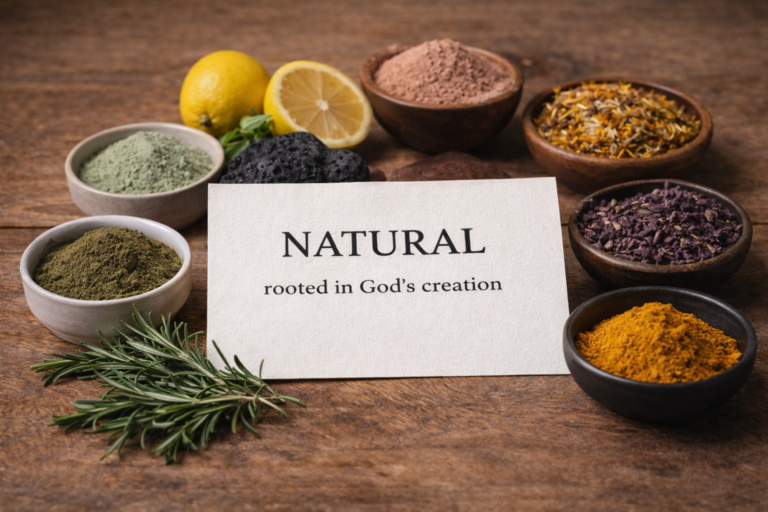
Natural ingredients in soap may not remain on the skin for long, but they matter to me because of where they come from. They originate in creation, not manufacture. They are simple, unaltered, and true.
While both natural and synthetic colorants are considered safe in rinse-off soap, I choose natural ingredients because they align with my values, my work, and the integrity I want reflected in every bar I make.
— Lord’s Soap & Skin Lab

Understanding Skin Contact, Saponification, and Why This Choice Goes Beyond Safety
When people ask whether natural ingredients are “better” in soapmaking, the conversation usually turns to safety, irritation, or chemical exposure. Those questions are valid, but they don’t fully address what matters most to me, especially in a product that is rinsed away.
Soap has brief contact with the skin. It is applied, worked into a lather, and washed off within seconds. Because of this:
- Most botanical compounds do not remain on the skin long enough to absorb
- Many plant constituents do not survive saponification
- Colorants, whether natural or synthetic, are largely rinsed away
- Cosmetic-grade mica, clays, and herbs do not penetrate the skin
From a strictly scientific standpoint, both natural colorants and cosmetic-grade mica are considered acceptable for use in cold process soap.
So if both are safe, why choose one over the other?
Where the Difference Actually Lies
For me, the difference is not about fear or claims of harm. It is about philosophy, integrity, and alignment.
Natural ingredients come from creation. They exist as whole materials, shaped but not invented. They carry variation, imperfection, and restraint. Mica, by contrast, is manufactured through multiple layers of processing and coating to achieve consistency and brilliance.
Even if neither remains on the skin in a meaningful way, their presence still matters.
Natural ingredients feel grounding. They support a simpler, quieter approach to craft. They align with how I want to work and what I want my products to represent.
This is not a claim about superiority in performance. It is a statement about orientation.
On Irritation and Sensitivity
Both natural and synthetic ingredients can cause irritation, depending on the person.
Natural materials may irritate due to:
- strong pigments
- plant acids
- texture or particulate matter
- overuse of certain clays
Synthetic materials may irritate due to:
- non-cosmetic pigments
- contamination
- added stabilizers or coatings
Irritation is personal. Even water can irritate compromised skin. Ingredient category alone does not determine response.
This is not where my decision is rooted.
What Guides My Choice
My preference for natural colorants comes down to a few steady principles:
Truth
Natural colorants come from creation. Synthetic pigments do not.
Simplicity
Natural materials require less intervention to exist as they are.
Integrity
My work is rooted in restraint, honesty, and material respect.
Connection to Creation
Using natural ingredients keeps my process grounded in what already exists, rather than what must be engineered.
Wholeness
Natural materials retain variation and character. They are not perfected, but they are complete.
So, Are Natural Soap Ingredients “Better”?
In terms of safety alone, both natural and synthetic colorants are acceptable in rinse-off soap when used responsibly.
But in terms of alignment, purpose, and meaning, natural ingredients are better for me.
Not because they are safer.
Not because they are more effective.
But because they are more true.
Closing Reflection
Soap does not stay on the skin long, but it carries intention. Ingredients may rinse away, yet the values behind them remain. Choosing natural materials shapes not only the product, but the integrity of the work itself.
And that is why I choose them.
— Lord’s Soap & Skin Lab