
What Does “Natural” Mean, Anyway?
To me, natural means ingredients that come straight from God’s creation. Not optimized. Not enhanced. Not corrected for consistency. Just materials as they were made, quirks included and performance reviews politely ignored.
I choose natural colorants not because synthetic options are unsafe or suspicious, but because natural materials align with how I want to work, what I want my products to communicate, and the kind of stewardship I believe matters. Even when mica offers more shimmer or reliability, natural feels more honest. Less polished, perhaps. More truthful, definitely.
Why “Natural” Isn’t a Marketing Term Here
The word natural gets used generously in the cosmetic world. Sometimes creatively. Sometimes optimistically. Often without much agreement about what it actually means.
Legally speaking, cosmetics don’t have a regulated definition of “natural.” The word can appear on a label even when the ingredient list quietly tells a different story. That isn’t a moral failing. It’s just the system we’re working in.
But in my work, natural isn’t a trend or a selling angle. It’s a philosophy.
It reflects a belief that what God created is already complete. Useful. Beautiful. And not in need of improvement through added sparkle, extra coatings, or carefully engineered perfection.
So What Does Natural Mean to Me?
Natural means an ingredient begins its life close to how it was made.
Not invented in a lab.
Not engineered for uniformity.
Not coated to behave better.
Not corrected to look brighter than it naturally wants to be.
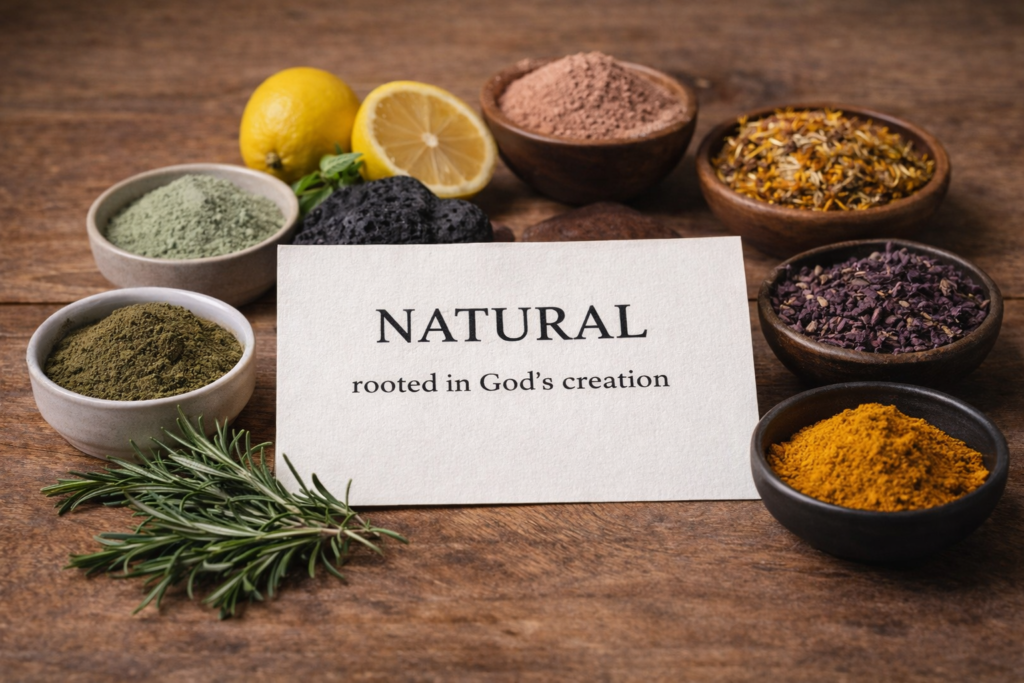
Natural colorants come from things like:
- clays and mineral earths
- plants, leaves, and roots
- seeds, fruits, and vegetables
- charcoal
- herbs and bark
They come from the ground. And they remember it.
Natural Does Not Mean Perfect (Thank God)
One of the things I love most about natural colorants is that they refuse to cooperate perfectly.
They change with the season.
They respond to soil and climate.
They deepen, fade, or surprise over time.
They behave differently from batch to batch, even when treated exactly the same.
To some soapmakers, this feels inconvenient.
To me, it feels like reality.
Creation isn’t uniform. It isn’t industrial. And it certainly isn’t identical from one corner of the earth to another. Natural colorants reflect that truth beautifully, sometimes stubbornly, and often humbling the maker in the process.
Soap has a way of reminding you that control is overrated. And usually unnecessary.
God-Made vs. Man-Made
We live in a world full of:
- lab-grown solutions
- chemically enhanced finishes
- stabilized colors
- coated pigments
- engineered perfection
Choosing natural materials is my way of stepping back.
Not out of fear.
Not because synthetic automatically means harmful.
But because I want my work to point toward creation, not replacement.
Natural doesn’t mean rejecting science. It means remembering who authored the original design.
The Comfort of Simplicity
Natural colorants align with simplicity in a way that feels grounding:
- simple sourcing
- simple processing
- simple variation
- simple expectations
They don’t rely on chemical coatings, layered pigments, or industrial sparkle. And honestly, that’s part of their appeal.
There’s something reassuring about working with materials that don’t try to impress you. They just show up as they are and quietly ask you to pay attention.
Alignment Matters
My brand is rooted in nature, restraint, and honesty. Using natural colorants reinforces that identity without explanation. Even though mica is safe and undeniably beautiful, it doesn’t feel aligned with the heart of the work I’m doing.
That doesn’t make mica wrong.
It simply makes it not mine.
A Personal and Spiritual Conviction
At its core, this choice is spiritual.
God’s creation is whole.
Human substitutes may be clever, but they aren’t foundational.
Working with natural materials keeps me connected to the earth He made and reminds me that beauty doesn’t require correction. Often, it requires less interference and a little more trust.
In Summary
When I say natural, I mean:
- God-made
- simple at its core
- unaltered in intent
- grounded in the earth
- honest rather than perfected
- varied, imperfect, and alive
- aligned with my faith and my work
Natural colorants aren’t just a preference. They’re a reflection of how I want to show up at the bench.
And that’s why they remain the foundation of my craft.