
Understanding Natural vs. Synthetic Mica
In artisan soapmaking, few topics generate as much conversation as color. Specifically, the question of natural colorants versus mica. Both can produce beautiful soaps. Both have their place. But their origins, processing, and underlying philosophies are very different.
For makers like me, those differences matter.
Before going further, I want to be clear and charitable at the same time:
I choose natural colorants over mica.
Not out of fear.
Not out of judgment.
And not because mica is unsafe or improper.
I simply choose natural because it aligns with my values, my work, and my understanding of stewardship. Mica has a place in the soapmaking world, and I respect those who use it. It just isn’t the foundation I’ve chosen to build on.
— Lord’s Soap & Skin Lab
A Brief Look at What MICA Actually Is
Mica begins as a naturally occurring mineral known for its reflective, shimmering properties. It has been used for centuries, and in modern soapmaking it’s prized for creating bright, vivid, eye-catching colors.
There are two primary forms used in cosmetics:
- Natural (mined) mica, sourced from the earth
- Synthetic (lab-grown) mica, created to replicate and enhance mica’s sparkle
Visually, the end result can look nearly identical. Philosophically and materially, they are not.
Natural (Mined) MICA: Earth-Origin, Heavily Altered
Natural mica sounds appealing at first glance. After all, it comes from the ground. But the mineral in its raw state is not what ends up coloring soap.
Before mined mica becomes usable as a pigment, it must be:
- extracted and washed
- ground into fine particles
- chemically bonded to colorants
- coated with synthetic pigments
- processed with heat
This leads to an important distinction:
Natural mica is only truly natural before it is colored.
The bright blues, purples, greens, pinks, and golds we see in soapmaking do not come from the earth itself. They come from added pigments such as iron oxides, ultramarines, titanium dioxide, and other lab-created colorants. Even the most transparent suppliers acknowledge this.
There are also ethical considerations surrounding some mica mining operations, including environmental damage and labor concerns. While efforts toward ethical sourcing exist, the finished pigment is still a heavily processed material.
Synthetic (Lab-Grown) MICA: Beautiful, Consistent, and Entirely Manufactured
Synthetic mica, often called fluorphlogopite mica, is created in a laboratory to mimic and enhance natural mica’s reflective properties.
It is:
- intensely bright
- highly consistent
- extremely stable
- free from mining concerns
- visually impressive
It is also:
- fully manufactured
- chemically colored
- heat processed
- entirely man-made
It never comes from the earth. It imitates creation rather than originating from it.
And that distinction matters to me.
Why Both Forms Are Still Human-Modified Pigments
Although “natural” and “synthetic” mica sound like opposites, the end result is remarkably similar:
A pigment that requires human intervention, chemical enhancement, and manufacturing to become what it is.
Whether mica begins in a mine or a lab, the finished colorant:
- does not remain in its original form
- relies on synthetic coatings
- is engineered for performance and appearance
Because of this, I don’t consider mica a natural colorant in the way I define natural for my work.
Why I Choose Earth-Based Colorants Instead
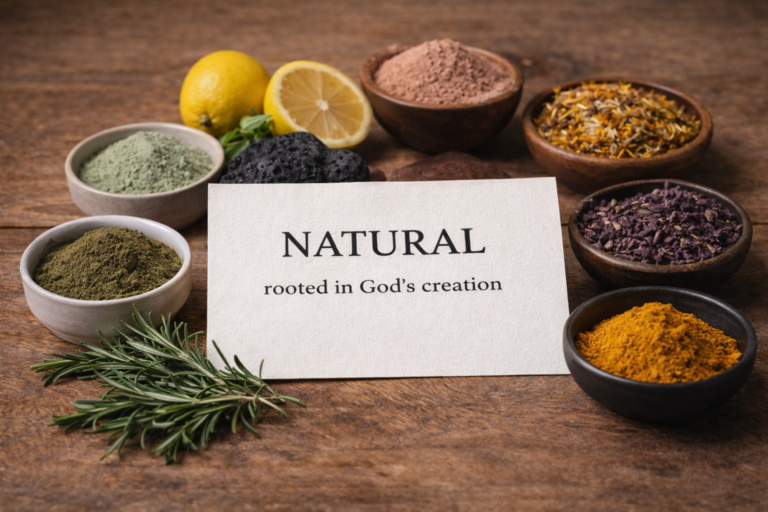
Botanical and earth-based colorants, such as clays, roots, herbs, charcoal, and mineral earths, come from creation as they are. They are shaped, not invented. They don’t promise perfection, and they don’t always cooperate.
Where mica feels:
- engineered
- controlled
- perfected
Natural colorants feel:
- grounded
- alive
- variable
- honest
They change with seasons. They surprise you. They refuse to be identical batch after batch. Soapmaking with them requires attention rather than control.
And frankly, that feels appropriate.
God’s creation is not uniform. Leaves vary. Soil shifts. Color deepens and fades. Natural pigments behave the same way, and I see that not as a limitation, but as a reminder.
Soap has a way of humbling you if you let it.
Where I Stand (For Now)
I do not currently use mica in my soaps. It doesn’t reflect the natural, God-centered foundation I want my work to rest on.
That said, I’m not issuing a lifetime ban or making promises carved in stone. If a future design truly requires an effect botanicals can’t provide, I’m willing to reconsider thoughtfully.
But for now, and for the identity of my craft, natural colorants remain my standard. Not because they are flashy or predictable, but because they are true to the materials as they were created.
And that matters more to me than sparkle.
— Lord’s Soap & Skin Lab