
Section 2: What Is Mica, Really?
Mica is a mineral known for its shimmering, reflective quality. In its raw form, it appears as thin, glittering, sheet-like flakes found in the earth. On its own, it’s subtle. Quiet. Honestly, a bit humble.
The vibrant blues, purples, pinks, and golds we see in soapmaking don’t come from that raw mineral.
To become colorful, mica must be coated with synthetic pigments. These pigments are created in labs and include dyes, oxides, FD&C colorants, and ultramarines. The mineral provides the sparkle. The laboratory provides the color.
This is why Mad Micas, one of the most respected suppliers in the industry, states plainly:
“There are no colored micas that are 100% natural.”
Even when a label says natural mica, it refers only to the mica plate itself. The color is still the result of human engineering.
In short:
- The shimmer comes from the mineral
- The color comes from the lab
That doesn’t make mica bad.
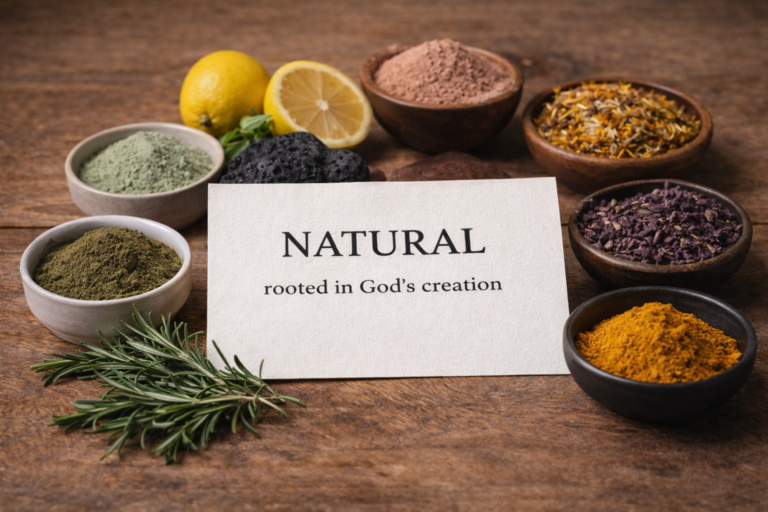
It simply makes it something different than a clay, root, or botanical pulled straight from the earth.
How Mica Becomes a Cosmetic Pigment
Understanding mica helps explain why it occupies a different category than natural colorants.
The process generally looks like this:
- Mica flakes are mined or grown in a laboratory
- The flakes are ground into fine particles
- Those particles are coated with synthetic pigments
- Heat and chemical bonding are used to stabilize color and shine
The end result is a vibrant, shimmery pigment designed to be predictable, stable, and visually striking.
Some suppliers use synthetic (lab-grown) mica to avoid ethical mining concerns. While this solves important issues related to sourcing, the final pigment is still entirely manufactured.
It never grows.
It never rests in soil.
It never surprises anyone.
Why So Many Soapmakers Love Mica (And Why That Makes Sense)
Mica has real strengths, and it deserves to be acknowledged honestly.
Soapmakers who value precision and artistic control often choose mica because it offers:
Vibrancy
Mica produces intense, saturated color that botanicals simply can’t replicate.
Stability
It holds color beautifully through saponification, rarely morphing or fading.
Shimmer and Sparkle
Metallics, pearlescence, and glitter-like effects belong to mica alone.
Predictability
Engineered pigments deliver nearly identical results every time, which is especially helpful for intricate designs.
These qualities make mica a legitimate and beautiful artistic tool. I respect soapmakers who use it well and thoughtfully.
Why I Choose Not to Use Mica
Despite its strengths, mica doesn’t align with the heart of my work.
My philosophy centers on simplicity, restraint, and staying close to creation. Mica, no matter how responsibly sourced or cosmetic grade, is still:
- processed
- coated
- engineered
- chemically enhanced
- dependent on lab-created pigments
In other words, mica is not a natural colorant in the way I define natural for my craft. It is a manufactured pigment built upon a mineral base.
Beautiful? Yes.
Botanical? No.
And for me, that distinction matters.
Where I Stand (For Now)
At present, I do not use mica. It doesn’t reflect the natural, grounded, God-centered aesthetic I feel called to uphold.
That said, I don’t believe in carving absolutes into stone tablets unnecessarily.
If a future project genuinely requires a shimmer or precision that botanicals can’t provide, I reserve the right to reconsider thoughtfully and with intention.
Mica isn’t forbidden.
It’s simply not aligned with my work right now.
And that’s okay.
— Lord’s Soap & Skin Lab