

Not because the ingredients change.
Not because the label changes.
But because the context changes.
Where something is sold quietly shapes what it becomes in the hands of the buyer.
A product placed on a clearance rack speaks one language.
A product placed in a thoughtfully built space speaks another.
The soap is the same.
But the story around it is not.
The Marketplace Shapes Meaning
A product can live in many environments:
- Crowded online marketplace
- Boutique shelf
- Farm stand
- Homestead table
- Chain store
- Curated local shop
Each carries its own rhythm, expectations, and pace. Each carries its own rhythm, its own expectations, its own pace.
But environment influences perception.
A bar of soap sold as a commodity competes on price.
A bar of soap sold as craft invites conversation.
A bar of soap sold as stewardship carries responsibility.
The space surrounding a product becomes part of its identity.
Intention Matters
When we place something into the world, we are choosing its context.
- Are we asking it to compete?
- To shout?
- To race?
- To discount?
- Or are we inviting it to serve?
- To endure?
- To be used slowly?
For us, this question matters deeply.
Because what we make is not mass-produced.
It is measured, cured, wrapped, and prayed over in the quiet of Morris Chapel, Tennessee.
And the space where it lands should reflect that care.
Not Better. Just Aligned.
This is not about superiority.
It is about alignment.
There are wonderful products sold in large marketplaces.
There are thoughtful makers who thrive in high-volume spaces.
There are customers who prefer speed and convenience.
But we are building something slower.
- More deliberate.
- More rooted.
- Where a product is sold should reflect how it was made.
If it was crafted with intention, it should not be treated as disposable.
If it was made to nourish, it should not be rushed.
If it was built on legacy, it should not be reduced to a transaction alone.
Stewardship Over Scale
We believe stewardship shapes value.
Stewardship of ingredients.
Stewardship of pricing.
Stewardship of customer trust.
Stewardship of the spaces where our work is placed.
A product does not just carry oils and lye and tallow.
It carries decisions.
It carries philosophy.
It carries the quiet conviction that honest work still matters.
A Different Pace
There is a kind of growth that stretches wide.
And there is a kind of growth that grows roots.
We are choosing roots.
That may mean fewer shelves.
That may mean fewer channels.
That may mean a slower build.
But it also means consistency.
Clarity.
Alignment between what we say and where we stand.
The Quiet Question
Every maker must answer this:
Where do I want my work to live?
Because where it lives will shape how it is perceived.
And how it is perceived will shape how it is treated.
We are not interested in being everywhere.
We are interested in being faithful where we are placed.
And that, in the end, changes everything.
One of the quiet decisions behind any handmade product isn’t whether to sell it, but where.
That choice carries more weight than people often realize.
Selling on a large marketplace like Amazon or Walmart is fundamentally different from selling through your own website. Neither is automatically right or wrong. They are simply built for very different purposes, and understanding that difference matters, especially for small makers.
Marketplaces Are Built for Scale
Large marketplaces are designed to move a lot of product, very quickly, to a lot of people.
They are optimized for:
- Volume
- Speed
- Consistency at scale
- Competitive pricing across thousands of similar listings
To operate there, sellers must meet extensive requirements, including:
- Platform fees and commissions
- Fulfillment fees or strict shipping timelines
- Packaging and labeling standards specific to the platform
- Inventory forecasting and restocking expectations
- Advertising costs just to be visible among competitors
None of this is accidental. These systems work extremely well for businesses built to produce, store, and ship at volume.
They are less forgiving for makers whose work depends on small batches, careful pacing, and hands-on quality control.
The Hidden Costs People Don’t Always See
When people say, “Why not just sell on Amazon?” they usually mean well. What they often don’t see are the layered costs behind that suggestion.
Beyond the obvious platform fees, there are indirect pressures:
- The need to price competitively against mass-produced goods
- The expectation of rapid fulfillment regardless of season or capacity
- The reality that visibility often requires paid advertising
- The risk that speed begins to dictate decisions meant to be thoughtful
For a hand maker, those pressures can quietly change the work itself.
Not all at once. Gradually.
Websites Are Built for Relationship
Selling through your own website is not easier. In many ways, it is harder.
You are responsible for:
- Traffic
- Communication
- Education
- Trust
- Fulfillment
- Customer care
But what a website offers that marketplaces cannot is context.
It allows space to explain why something is made the way it is. It allows direct feedback instead of anonymous reviews. It allows slower growth without penalty.
Most importantly, it allows responsibility to remain personal.
When someone buys directly, they aren’t buying from a system. They are buying from a person.
Responsibility Changes the Pace
For a maker who cares deeply about ingredients, sourcing, and consistency, pace matters.
Selling at scale before a product has been thoroughly lived with, used, and understood by real people can create pressure to choose speed over stewardship.
That doesn’t mean scale is wrong. It means timing matters.
Starting on a website allows a product to grow roots before branches.
Why This Matters to Me
When something works, when people rely on it, responsibility increases.
Where you sell determines:
- How fast you must move
- How loudly you must market
- How much margin you must surrender
- How much flexibility you retain
These are not abstract business decisions. They affect how something is made, how often it can be made, and how carefully it is offered.
“In all your ways acknowledge Him, and He will make your paths straight.”
— Proverbs 3:6
Discernment isn’t about rejecting tools. It’s about using the right ones at the right time.
This Is Not a Rejection of Marketplaces
Amazon and Walmart serve millions of people well. They excel at what they were built to do.
But they are not neutral spaces. They shape behavior.
For hand makers, entering those platforms too early can quietly ask the work to become something it was never meant to be.
Choosing to begin elsewhere is not fear. It’s attentiveness.
A Different Kind of Success
Success isn’t only measured by reach.
- Fewer products, crafted carefully.
- Growth that does not outrun integrity.
- Conversation that builds trust.
- Decisions made without panic.
That kind of success doesn’t scale quickly. But it lasts.
And for now, that’s the responsibility I’m choosing to carry.
Handcrafted in Morris Chapel, Tennessee.
Built slowly. Meant to last.
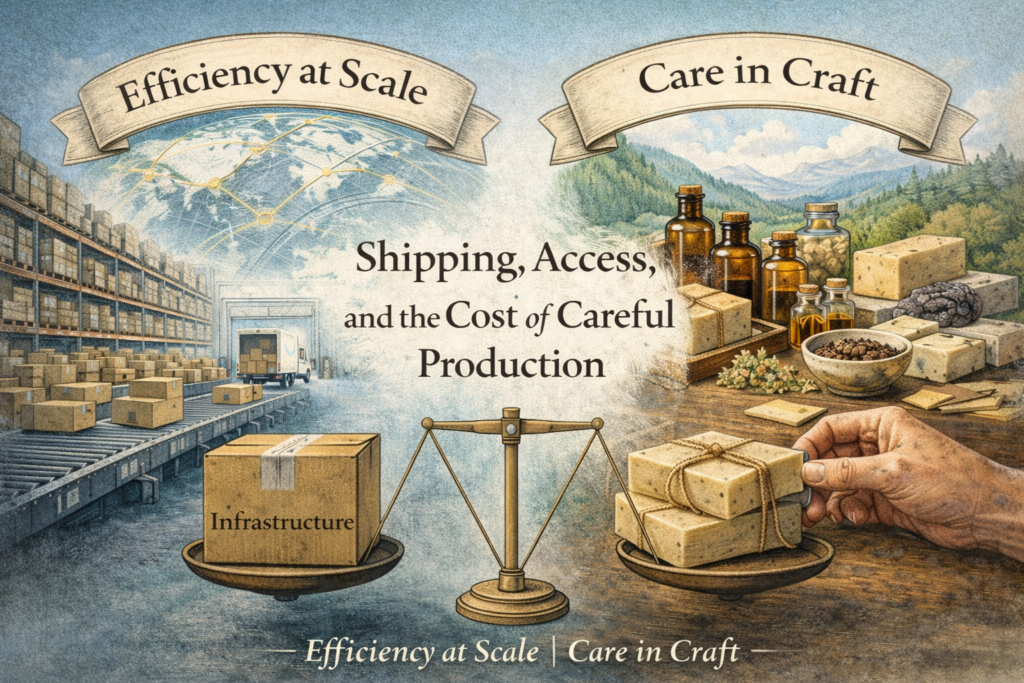
One of the great strengths of large marketplaces is simple and undeniable:
They make shipping feel effortless.
Fast delivery. Predictable costs. A few clicks and something arrives on your doorstep within a day or two. For many households, that convenience is not just enjoyable, it is practical.
There is nothing wrong with appreciating efficiency.
In fact, when infrastructure is built well, it can serve customers exceptionally well.
Why Shipping Feels Different at Scale
Large platforms are able to distribute shipping costs across enormous volume:
• Millions of packages moving daily
• Membership models like Prime
• Negotiated carrier contracts
• Automated fulfillment networks
The result is lower visible shipping costs and faster delivery for the customer.
That efficiency is not accidental. It is infrastructure.
And when used responsibly, infrastructure can reduce cost and increase access.
What Shipping Looks Like While Growing
For a small maker building carefully, shipping begins differently.
Each order involves:
• Individual packing
• Careful handling
• Protective materials selected intentionally
• Real-time carrier rates
There is no vast system absorbing costs in the background. What the customer sees is simply the true cost of moving a small-batch product safely.
That visibility is not inefficiency.
It is transparency during the building phase.
Growth Changes the Equation
As a business matures, new options become possible.
When formulations are stable, production is consistent, and quality is repeatable, broader fulfillment networks can become a tool rather than a compromise.
Large-scale shipping does not have to replace careful making.
It can support it.
For customers, that may mean:
• Lower shipping costs
• Prime delivery options
• Greater accessibility
• Easier reordering
The product can still be formulated with intention.
The delivery system simply becomes more efficient.
Care Does Not Disappear When Scale Appears
Care happens long before shipping.
It happens in:
• Ingredient selection
• Formulation discipline
• Small-batch testing
• Honest labeling
Once those foundations are strong, expanding distribution does not weaken them.
It extends their reach.
That is the difference between chasing convenience and preparing for it.
Why This Matters
I believe in building carefully first.
Stabilize the product.
Refine the process.
Protect the standards.
Then, when growth allows, use the tools that serve customers well.
Infrastructure can lower costs.
Prime shipping can improve convenience.
Access can increase without reducing integrity.
“Better is a little with righteousness than great revenues with injustice.”
— Proverbs 16:8
Integrity remains the anchor.
Distribution can evolve.
A Clear Path Forward
There are seasons for building slowly.
There are seasons for expanding access.
For now, careful production remains the foundation.
As the business grows, thoughtful expansion may follow.
The standard does not change.
Only the reach does.
— Jonah Lord Henry
For Lord’s Soap & Skin