FREE SHIPPING $30+ Handcrafted with Purpose • Rooted in Faith

Natural Soap Colorants vs Micas: Which Is Better?
Natural soap colorants offer something different. Rather than perfect consistency, they provide character, uniqueness, and the kind of one-of-a-kind beauty that makes each batch feel alive.

Natural soap colorants offer something different. Rather than perfect consistency, they provide character, uniqueness, and the kind of one-of-a-kind beauty that makes each batch feel alive.One question I hear frequently is:
Should I use natural soap colorants or micas?
The answer depends entirely on your goals as a soapmaker.
If your priority is creating vibrant, highly predictable colors that can be replicated from batch to batch, micas offer significant advantages. If your goal is to explore the beauty, complexity, and individuality of nature’s palette, natural soap colorants provide a very different experience.
Why Soapmakers Choose Micas
Micas are popular because they offer consistency.
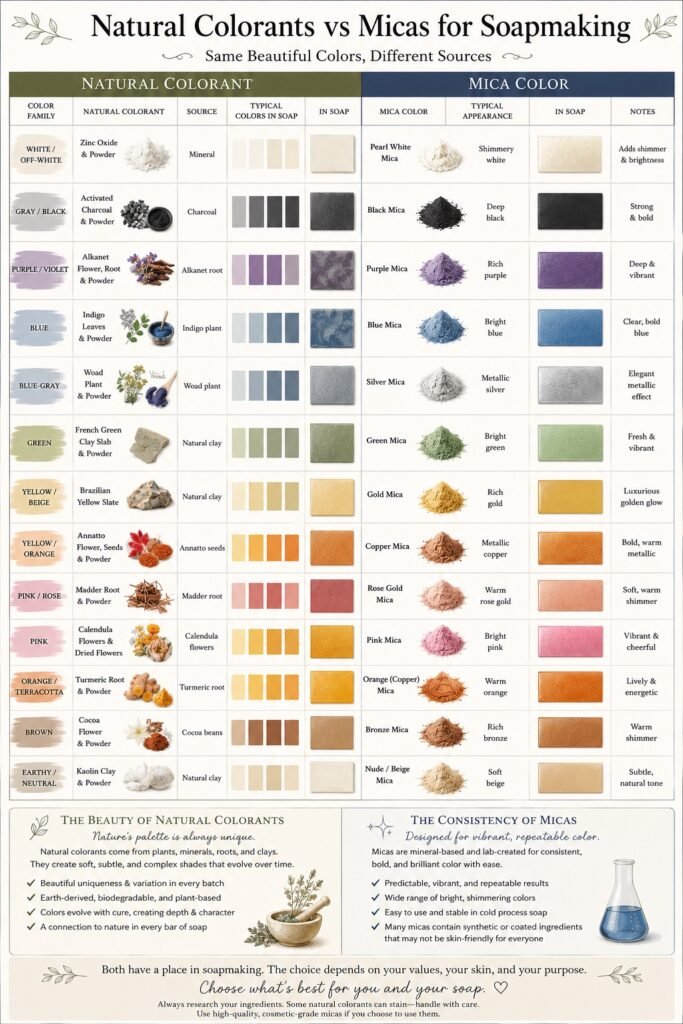
Colors are vibrant, predictable, and repeatable. Whether you want a bright turquoise, deep purple, vivid pink, or shimmering gold, micas make it possible to achieve those shades with a high degree of confidence. For soapmakers who sell products and need reliable color matching from one batch to the next, this predictability can be extremely valuable.
Micas offer access to a wide palette of vibrant, repeatable colors, while natural colorants tend to excel in earthy, muted, and beautifully complex shades.
Why Soapmakers Choose Natural Colorants
Natural soap colorants offer something different.
Rather than perfect consistency, they provide character, uniqueness, and the kind of one-of-a-kind beauty that makes each batch feel alive.
Roots, clays, botanicals, herbs, spices, and infused oils each bring their own personality to a batch of soap. Colors often evolve during cure, creating unique shades and subtle variations that cannot be perfectly duplicated.
A bar colored with alkanet, annatto, indigo, woad, activated charcoal, or clay reflects not only the ingredient itself but also the formulation, temperatures, cure conditions, and countless small variables that make each batch unique.
For many soapmakers, that connection to nature is part of the appeal.
There is a certain excitement in watching a color develop over time. The shade you pour is not always the shade you unmold, and the shade you unmold may not be the shade you see six weeks later. Every batch becomes part science experiment, part artistic expression, and part lesson in patience.
The Tradeoff
Micas provide control.
Natural colorants provide discovery.
Micas help create the exact color you planned. Natural colorants often reveal colors you never expected.
Neither approach is inherently right or wrong. Both have strengths, challenges, and devoted supporters within the soapmaking community.
For my own work, I enjoy exploring what nature can accomplish inside a soap mold. There is something deeply satisfying about watching a natural colorant evolve through saponification and cure, revealing shades that no color chart could have fully predicted.
Continue Exploring Natural Colorants and Micas
This article is part of a larger series examining the differences between natural colorants and micas in artisan soapmaking. If you’d like to dive deeper into the topic, continue with these articles:
- Natural Colorants vs. Mica in Artisan Soapmaking (Part 3)
https://lordssoapandskin.com/natural-colorants-vs-mica-in-artisan-soapmaking-3/ - Natural Colorants vs. Mica in Artisan Soapmaking (Part 4)
https://lordssoapandskin.com/natural-colorants-vs-mica-in-artisan-soapmaking-4/ - Natural Colorants vs. Mica in Artisan Soapmaking (Part 5)
https://lordssoapandskin.com/natural-colorants-vs-mica-in-artisan-soapmaking-5/ - Natural Colorants vs. Mica in Artisan Soapmaking (Part 6)
https://lordssoapandskin.com/natural-colorants-vs-mica-in-artisan-soapmaking-6/
Together, these articles explore performance, consistency, sourcing, creativity, and the remarkable beauty that both natural colorants and micas bring to handmade soapmaking.
— LORDS SOAP AND SKIN LAB